EARLY-STAGE UX STRATEGY · PRODUCT OWNERSHIP
Climate Rewards Web App
Owning product direction for a pre-seed Toronto startup. Working directly with the founder to define what to build, who to build it for, and why, before a single screen was designed.
-portrait.png)
-portrait.png)
-portrait.png)
-portrait.png)
ROLE
Sole UX Designer
TYPE
0→1 Product Ownership + UX
TIMELINE
Oct – Dec 2025 · Part-time
FOCUS
Strategy, Screens, IA
OVERVIEW
About this project
Carbon Mutual is a pre-seed Toronto startup building a platform that rewards individuals for making low-carbon choices. Users earn a digital reward currency called "Carbits" when they make a verified sustainable actions like biking or shopping locally. They redeem Carbits at partner businesses.
I joined as the sole UX designer via a Riipen work-integrated learning engagement. Unlike a typical design role, this wasn't a brief-and-deliver relationship. I worked directly with the founder in 1-on-1 sessions, challenging assumptions, proposing product directions, and making tradeoffs. The engineering team was building in parallel which meant my decisions had real consequences for what got built.
ROLE
UX Design Specialist (sole designer, working directly with the founder)
TEAM
Founder (John), 4 engineers, Sustainability market researcher (Bri)
TIMELINE
October – December 2025, part-time (~300 hour engagement)
WHAT I OWNED
Product direction, feature scope, personas, IA, core flows, early UI
The Working Model
This wasn't a traditional design engagement where briefs arrive and designs get delivered. I drove product direction by defining what to build, cutting what didn't matter, and setting the strategic foundation before development began.
THE PROBLEM
Making sustainable behavior actually rewarding
For most people, sustainable choices are invisible. The carbon impact of any one decision is hard to measure, and doing good rarely comes with a tangible benefit. Carbon Mutual's bet: reward the right behavior immediately and visibly, and people will change their habits.
Three problems shaped the product direction:
Problem 1
Carbon impact is invisible and hard to feel
Numbers like "2.3kg CO2e saved" mean nothing without context. The product had to make abstract impact feel real and personal.
Problem 2
No real-time incentive to change behavior
Choosing a low-carbon option costs more and takes more effort. Without an immediate reward, there is no reason to change a habit.
Problem 3
Too many possible features. So who do we design for first?
This was not a design problem. It was a product problem. Dozens of behaviors could be rewarded. Without clear priorities, the product would try to serve everyone and succeed with no one.
PRODUCT DIRECTION
Defining the core loop before designing anything
Before touching screens, I worked with the founder to answer one question: what makes someone come back tomorrow? The answer became the behavioral engine the entire product is built around. If a feature did not support one of these five stages, it did not belong in the MVP.

PRODUCT DECISION
The biggest product challenge wasn't design. It was deciding what to build first.
The founder wanted to reward every sustainable behavior such as biking, transit, thrift shopping, local grocers, household waste, family businesses, and more. Without prioritization, the product would try to serve everyone and fail everyone.
I pushed back. My question: who are the first 500 people who would actually use this? That forced a real answer.
Working with the founder and Bri, I narrowed the list using persona research and the Toronto launch strategy. This is the kind of tradeoff that separates product thinking from execution. Anyone can design for an infinite feature list. Deciding what not to build takes judgment.
THE PRODUCT DECISION
Two priority behaviors for the Toronto pilot: biking and transit (streak-based, GPS verifiable) and thrift and local eco-shop purchases (receipt scan verification).
These covered both target personas, required the least complex verification infrastructure for V1, and had clear redemption value from day one. Everything else moved to a Phase 2 backlog.
This scope decision cascaded into everything that followed. Which earn flows to design first. Which partner categories to show. What the Dashboard surfaces. The scope choice shaped the product. The product shaped the screens.
USER RESEARCH
Who we were designing for
Instead of designing for "anyone who cares about sustainability," I defined two specific early adopter profiles. These personas drove every product and design decision. The guiding question: would they realistically shop at our partner merchants? If not, the rewards loop fails before it starts.
🚲
Eco-active Audrey
GAMIFICATION
STREAKS
SOCIAL PROOF

Earns Carbits by biking (streak tracking) and thrift shopping (receipt scan)
Redeems for transit credits and local café discounts
Motivated by visible proof her lifestyle matters and wants to see and share impact
21 · University student · Downtown Toronto · bikes to campus, thrifts, volunteers in climate clubs
21 · University student · Downtown Toronto · bikes to campus, thrifts, volunteers in climate clubs
🛍️
Local Shop Lover Lena
33 · Small business employee · Hamilton · supports local grocers, ethical boutiques, family businesses
SIMPLICITY
TRANSPARENCY
COMMUNITY
Earns Carbits by shopping at local partner stores (receipt scan + local vendor map)

Redeems for discounts at partner stores or donates to sustainability projects
Motivated by her spending supporting local businesses and skeptical of greenwashing
MARKET RESEARCH
Grounding decisions in real Toronto context
Bri's Toronto Launch Strategy connected product decisions to real market opportunity. I used this research to align merchant categories, earn actions, and neighborhood targeting with where our early adopters actually live and shop.
Key insights from the Toronto Launch Strategy
PILOT NEIGHBORHOODS
The Annex · Queen West · Kensington Market · Leslieville · Yorkville
PARTNER CATEGORIES
Zero-waste stores · Thrift shops · Eco boutiques · Independent grocers · Co-ops
EARLY ADOPTER PROFILE
Eco-conscious students · Young urban professionals · Community-minded local shoppers
TORONTO GREEN ECONOMY
$6.55B sector · 60,000+ jobs · 430+ green companies · strong municipal support
INFORMATION ARCHITECTURE
Structuring the app around the core loop
With personas defined and scope narrowed, I mapped the 5 core sections of the app. Every section maps to a stage in the behavioral loop. I did not start with screens. I started with structure.
🏠 Home Dashboard — Carbit balance, impact summary, CO₂ avoided, next action nudge
💳 My Carbit Card — digital wallet, transaction history, barcode for in-store scanning
Carbon Mutual App
🌿 Earn Carbits — priority actions, category browse, partner map, receipt scan
🎁 Redeem — spend Carbits (partner discounts) vs support partners (donations)
👤 Profile / Settings — account info, linked data sources, privacy controls
5 core sections, each mapped to a stage in the Action → Proof → Reward → Motivation → Repeat loop
The Redeem split into two tabs was a product call, not a UX call. It lets the network grow in two directions simultaneously without forcing them to compete.
DESIGN EXPLORATIONS
Translating strategy into screens
With the product foundation set, I moved into early-stage UI design. These are not dev-ready screens. They were produced to establish visual direction, communicate the product concept to the founder and engineering team, and show how the core loop translates into actual interface decisions.
Every design decision in these screens traces back to a product decision. That is the work.
ALL SCREENS · EARLY-STAGE EXPLORATIONS
6 screens across 5 core sections of the app

-portrait.png)
-portrait.png)
-portrait.png)

-portrait.png)
Dashboard
Carbit Card
Earn Carbits
Redeem
Partners
Profile
01.
Dashboard surfaces the two priority behaviors, not a generic feed
The "Up Next" section shows exactly the two behaviors from the scope decision: biking with streak progress, and receipt scanning. Not a generic feed. The two behaviors we decided mattered most. The impact stats (8 actions, 7.2kg CO2 offset) turn invisible carbon into a personal progress score. Users cannot feel carbon. They can feel progress.
02.
The Carbit Card is a trust signal, not just a wallet
A physical NFC card is the founder's long-term vision. For V1, a scannable barcode does the same job with a fraction of the development cost. The dark premium card face with the user's name signals that Carbits hold real value. The activity log with color-coded earned and redeemed entries makes the currency feel real and transparent which is critical for a product asking people to change their behavior.
03.
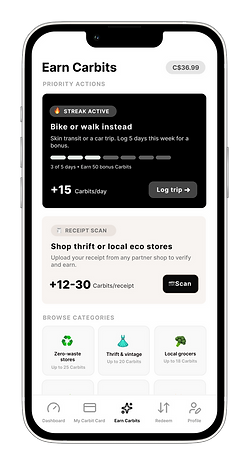
Earn: I designed the hierarchy to reflect which behavior matters more, not which looks better
Two cards, two behaviors, deliberately different visual weights. The dark card (biking) is the habit we want users to build. The light card (receipt scanning) is the lower-friction entry point. Dark outranks light. High-engagement outranks easy. The streak dots at 3 of 5 are intentional as a near-completion is a proven behavioral trigger. Users close to a goal are significantly more likely to act.
04.
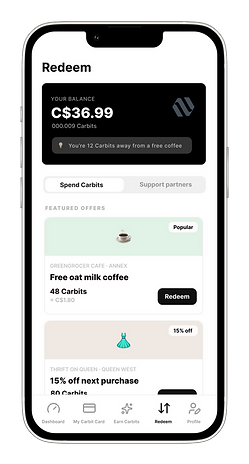
Redeem splits into two tabs as a business model decision
Spend Carbits (partner discounts) and Support Partners (donations) came directly from a founder conversation. Two tabs lets the network grow in two directions simultaneously: businesses that issue Carbits and organizations that simply accept donations. Both expand the ecosystem without competing. The nudge line ("12 Carbits away from a free coffee") is a deliberate behavioral trigger. Near-completion creates urgency.
OUTCOME
What I delivered

Drove product direction in direct collaboration with the founder by defining scope, cutting features, setting the foundation before development began

Defined the core behavioral loop that became the product's north star for every feature decision

Made the scope call and narrowed from 10+ possible behaviors to 2 priority actions for the Toronto pilot, using persona research and market data

Created 2 user personas that drove decisions about which merchants to partner with, what the Dashboard surfaces, and how Carbits are explained in the UI

Mapped full information architecture across 5 core sections, each tied to a stage in the behavioral loop

Designed early-stage UI across all 5 sections to establish visual direction and communicate the product concept to the engineering team
REFLECTION
What I'd do differently
The biggest thing I'd change: I would have pushed for a defined scope agreement earlier in the engagement. I spent a lot of time checking in with the founder to stay aligned rather than proposing a specific direction and defending it. There's a version of this project where I say "here are 2–3 options, which one?" instead of waiting for clarity that kept shifting.
I'd also have started the Earn flow wireframes much earlier or even a rough lo-fi sketch, before doing any visual work on the Dashboard. Having one polished screen while the core behavioral screens were still undefined created an imbalance that made it harder to hand off a coherent picture to developers.
The gap between junior and mid-level design is not years. It is demonstrated ownership. Making calls under ambiguity, pushing back on founders when the scope is wrong, and translating strategy into interface decisions that have real development consequences. That is what this project asked of me. That is the designer I am becoming.